
OTnews April/May 2026
Log in and read it today!
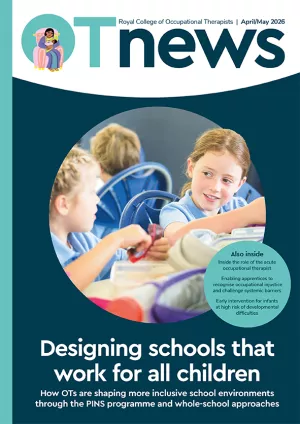
Delivering the right support, at the right time, lies at the heart of occupational therapy practice. It’s a principle that resonates throughout this April/May issue.
A particular focus this month is on children and young people, and the vital role occupational therapy plays in supporting neurodiverse pupils in mainstream education.
Elsewhere, attention turns to acute care, where OTs can often be narrowly associated with discharge planning. We examine how clinical expertise, meaningful occupation and positive risk-taking combine to support patient flow, while preserving what matters most to individuals.
Both these themes offer powerful examples of occupational therapy making a difference when systems are under strain.
Editor's picks
OT in acute care
Beyond discharge planning, acute occupational therapists blend clinical insight, meaningful occupation and positive risk taking to keep patients moving through an overstretched system.
In this issue, OTs, Lynsey Alexander and Doireann McCaughley, explore what the role really involves and share how they are demonstrating impact. This is followed by Lauren Walker, RCOT Professional Adviser, exploring the challenges and opportunities that members in acute settings currently face.
Lauren urges OTs to help RCOT influence national conversations and ensure our profession is recognised as a vital part of acute care, now and in the future.
OT in mainstream schools
The Partnerships for Inclusion of Neurodiversity in Schools (PINS) programme is a national initiative jointly funded by NHS England and the Department for Education. It aims to improve outcomes for neurodiverse pupils in mainstream education through collaboration between health professionals, education professionals and parent-carers.
In Surrey, this funding established neurodiversity advisors to link PINS services and schools.
In the first of two articles on this topic, Amy Hart and Deborah Levy share how the PINS programme has the potential to shape future occupational therapy delivery by driving environmental change in schools.
Ruth Morgan also explores the development, implementation and impact of Bournemouth, Christchurch and Poole Council’s Schools Occupational Therapy Sensory Outreach Service – designed to address a critical gap in sensory support for children in mainstream education.
If you're interested in sharing and connecting with other school-based OTs – join our School-based practice community on RCOT Communities.
From learner to changemaker: putting occupational justice into practice
Co-written by a lecturer and students, this article explores how critical theory, workplace insight and supported risk-taking enabled apprentices to recognise occupational injustice, challenge systemic barriers and influence everyday practice.