
What could promote autonomy more than giving someone a voice?
The importance of communication and Augmentative and Alternative Communication
We’re delighted to share this engaging and thought-provoking blog written by OT, Natasha Kay – an AAC Consultant at Ace Centre – exploring the importance of communication and augmentative and alternative communication.
Natasha is the AI and Technology Lead for the Inclusive Built Environments Network on RCOT Communities. This blog highlights some of the thought-provoking and engaging conversations our incredible network volunteers are having.
If you’re interested in leading or co-leading an area of your profession, Natasha says:
Being a network leader is an opportunity to build your OT skills and network, as well as share your knowledge. All of us, always, have more to learn, and the more we can share with each other, the better it will be for all of us and for our clients!
What could promote autonomy more than giving someone a voice?
Communication is central to most of our occupations, as well as being an occupation in its own right. We make jokes, ask questions, tell a carer the water in the shower is too cold, have conversations with friends, choose what shoes to wear, talk about what we did on the weekend and ask to listen to a specific song. But we don’t tend to think about how central communication is unless there’s a communication breakdown.
We all communicate in a variety of ways. We might use our voice, point at things, write things down and use our facial expressions and gestures.
What is Augmentative and Alternative Communication (AAC)?
For people who aren’t able to use their voice consistently and reliably, there are many ways to augment or replace verbal communication. This is typically referred to as Augmentative and Alternative Communication (AAC).
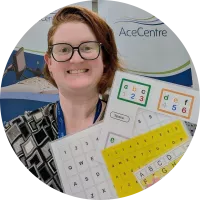
AAC can take many forms – examples include an alphabet chart, symbol chart, communication book or apps and devices that speak aloud.
People who use, or could benefit from, AAC need people around them who feel comfortable with AAC and how they communicate.
Our role
As OTs, we need to ask ourselves:
- do we have the skills we need to be a good communication partner?
- do we know how our clients say yes and no, and the communication tools they use?
- are we considering how we could integrate their AAC (or any AAC) into our OT sessions?
- are we considering communication as part of our holistic assessment?
Some of the most meaningful changes I make are with a laminated piece of paper and a qwerty keyboard.
While Augmentative and Alternative Communication squarely fits within Speech and Language Therapy, and their skillset is invaluable, there is a considerable role for OT within AAC and communication.
In the same way we work alongside our physiotherapy colleagues to look at walking and transfers, our nursing colleagues to look at pressure care and our social work colleagues to look at care packages (among many other examples) – we can also work alongside our Speech and Language Therapy colleagues to look at communication.
This might mean exploring ways to access communication if pointing is difficult, modelling AAC within our sessions and giving clients time to use their AAC system rather than deferring questions to family or carers.
Meaningful changes
Before moving into a specialist AAC role, I couldn’t have told you what AAC stood for. And I certainly wasn’t considering communication as often as I should have. Whereas now, some of the most meaningful changes I make are with a laminated piece of paper and a qwerty keyboard, asking how someone says yes/no, being comfortable with saying ‘sorry I didn’t understand that’ and just giving people the time and space to communicate.
The most important tools in my toolkit are patience and being ok with silence while waiting for someone to compose their response.
If you'd like to learn more, Communication Access UK offers training which is a great place to start.
Our sincere thanks to Natasha for this blog and her network Lead role!
If you’re an RCOT member, you can find more valuable insight and discuss the ideas from this blog with Natasha further on RCOT Communities.